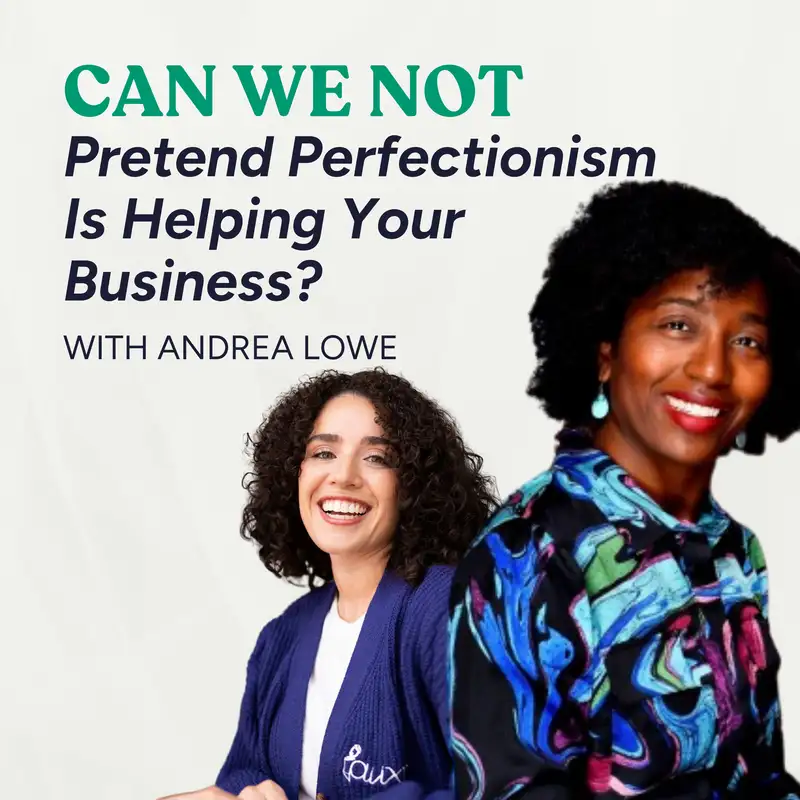
📍 📍 I tried so hard, like when I first started, like I was doing everything myself and I was trying so hard in order to like. Try to keep up a schedule. I had a process in place of course, and, and I'm trying to work this process and it got very overwhelming actually after a few months.
being a business owner, you have to be humble and where you're really good and where you're not so good.
And the sooner you can come to that, the sooner you can make a decision around it or, or find a solution. 📍
Somewhere along the way in your entrepreneurial journey, running a business got way more complicated than it needed to be. Between the advice that's built for eight-figure companies, systems that felt unnecessarily heavy, and strategies that sounded smart but didn't actually fit the way you work, you probably ended up putting in a whole lot of effort without getting better results.
Listen, business is hard enough. Can we not make it harder? So welcome to the Can We Not? Business Podcast. I'm Sam, and I'm all about uncomplicating the strategies and work of running a business so it can not only be profitable, but also enjoyable. At Auxo Business Services, I work with visionary doers who like to be busy, but want that effort to create momentum instead of more noise.
We're a back office agency that helps founders build support systems that actually work through US-based virtual assistants, recruiting for key roles, and tough love strategies that turn ideas into execution. Now, this show is for founder-led businesses with small teams or even no team at all yet. We're gonna talk about the behind-the-scenes decisions and real day-to-day work that shape your business so you can stop chasing the shiny objects, get out of second-guessing spirals, and simply be more profitable.
So let's get into it
📍 Today's guest I'm so excited for, she's always been such a bright and positive note for my day whenever I get the chance to meet with her. And she is a super amazing nonprofit consultant.
It's Andrea Lowe. Hi. How's it going?
This going well. Hey Samantha, how are you doing today?
I'm good. I'm good. And I am so excited to dive into your story today because I've gotten the pleasure or I've had the pleasure of kind of watching your growth from a distance a little bit, um, over the past few years. And so I'm excited to really. Dive into your world and really understand more about what you do.
So I know you've run Social impact, uh, which is nonprofit consulting, but tell me more about that because you say the word consulting and people think a million different things. So tell us what you actually do.
Sure. And I feel like when you talk about consulting, it can be a million different things. But, uh, here at Social Impact Studio Consulting, we are really at, at the core of it, helping people and helping organizations expand and extend their impact. That's the, that's the. Probably the core of what we do and the way that we do it is through helping them with planning and implementing their programs and services. We work specifically with organizations, both nonprofits and government agencies as well in health and human services or social services work. That includes community development and education as well, but. You know everything from like doing the strategic plan, planning out for your program, looking at your data, helping collect data, really developing everything with community in mind, so like community as partners, community as leaders with that work, and so that you create effective programs and services.
On a somewhat side note, I always appreciate any organization that has. A big focus on community because I think that's part of the downfall of society is like we don't really like engage in our communities. You know, like I, when I moved into this neighborhood I'm in now, I offered help to a few different moms in the neighborhood and the reaction.
They received it, but it was also like no one had ever offered them help for anything before. And I'm like that we're meant to live in community and helping our neighbor right now. We, we joked that consulting can mean a whole bunch of different things, and I also think that that is a trap that you can easily see in the nonprofit world, right?
These are people leading from their heart, very mission oriented, which is amazing. But I imagine that that also means that they end up wanting their impact to kind of be everything, a little bit of spaghetti on the walls. Uh, and so how do you kind of rein them in so that they can have, uh, maybe a stronger impact, but not everywhere.
Um, well, starting with what you love to do, like I think people, sometimes they forget. To even just kind of center themselves in the work. Like what do you love to do and what are you really good at? So starting there and at the central core, but then also taking a look at your community. What are the resources there?
What, you know, how are, um, you know, are there other organizations doing similar work or other work in the, in the community or maybe not even organization. It could be like a person who's like bringing together people to do, uh, to. Bring food into the community or something like that. Um, where are all those things in your community?
And so that way you can look at that nexus of what you're really good at with what's already there, to understand where the gap is and that kind of brings you to your unique contributor to your community work.
Now that's such like an applicable theory for business. I know we're kind of going off off our script a little bit, but what you're saying is intriguing because, what you're describing is like seeing what's, what the market needs and then responding to the market and, and, and filling the gap. And if we bring it back to the consulting world, that's a super saturated industry.
Right. And, and I'm sure you've also felt like there's so many nonprofit consultants. I think you're also part of a mastermind specifically for nonprofit consultants. So then how do you then, for yourself and for social impact, like differentiate and say like, this is what's unique about how we approach.
Working with nonprofits.
I think for us it's really, again, it gets back to like how we work, bringing our own background and experiences. To the table. And then also, you know what I think is really great about being a smaller consulting firm and there are a ton of small consulting firms out there is the opportunity to collaborate with other consulting firms.
So like that way we're all bringing our best gifts together to create a really great, uh, team. In response to an organization's needs. So sometimes we're doing things on our own just within social impact studio consulting, but like a lot of times also we're working with other organizations, other consultants in a collaborative sense to really fill out a team for an organization as well.
Ooh, collaboration over competition. I think that that is, that's a tough thing for some people to really get on board with. But I, I wanna pick, you mentioned something of like the uniqueness of, of your background, right. And, and kind of pulling on that, when you're working with clients and you have a cool background where you came from quite a bit of government work, right.
Can you tell our listeners, uh, what you did before your consulting firm?
Sure. So before my consulting firm, I worked for about 15 years in the field working particularly within public health departments, but also social services or human services departments at the local and the state level. I've also worked for a few nonprofits at the local level. And kind of more the national level. And with that work I was doing strategic planning. I was doing a lot of policy and advocacy work. Um, a lot of program implementation as well, and, constituent services work as well. Um, probably my most recent job before, starting my consulting firm I was working in, in the Midwest in Nebraska, for their Department of Health and Human Services.
I almost wanted to move to Nebraska. But now with that, and I'm gonna speak a little bit ignorantly, uh, to maybe how some things operate when you do have like a, a government based role. I'm assuming that there's some things that are quite rigid, right? And there's so much paperwork and it's so process oriented sometimes.
And when you become an entrepreneur, you, you can't do that. You can't operate like that. You have to be much more nimble and flexible. So were there bad habits from your government work that you had to try to break when you became an entrepreneur? Or like how did one influence the other?
Um, that's a great question. So I, I dunno if I would call it bad habits, but I think very much like working in government work, there is a process for pretty much everything. It's rare to. Okay, now I've gotta create a process for that. Unless it's a completely new program, completely new service, that kind of thing.
And then you're, the first thing you're doing is creating a process for it. So I feel like in government there's generally like one right way to do things. Um, myself though, like I. I don't necessarily felt, I, even when I worked in government and in nonprofits as well, like, I didn't really necessarily feel that way.
I was always like, okay, yes, this is the process I'll follow the process, but I might do some little extras to, to move things along a little bit faster. And so that was always
Hmm.
for me, to do. And so I feel like I've carried that piece over, um, to my consulting work and to my entrepreneurial work. But I think there's still also a level of, the like need for process and the need for systematizing things that I bring over as well. That can be really helpful, but also kind of hard because now I'm actually creating all those systems and all those processes from scratch as opposed to like them just being there and existing and you're just learning them.
Yeah, you're like, where is my custom library of SOPs? Why does it not already exist for my business? Right. But the, I do see how that could be very beneficial. Right. We definitely have, like I know some clients who are very much ping pong balls and like they're always changing what they're doing and so if you are already coming into your work knowing that you need some structure and having like a respect for structure and process, I could see how that might accelerate other parts.
Of your business. And so with that, do you feel like you really, like you leaned into your previous network of like whoever you had met from your government work. Did you lean into that when you first started your business or was it kind of building your network and your client base from scratch?
It was a little bit of both, so, um, I actually, when I started my business, I was actually moving. I live in pi. Pennsylvania now. So I moved from Nebraska to Pennsylvania and that kind of started my impetus for starting the business. So I had my existing networks from Nebraska, but then also other states.
'cause I moved all, all around the United States. And so I was able to share with them. About the start of my consulting work and, and leverage them. But then also being new to Pennsylvania and to kind of the area that I'm in, I was, I started building new networks as well, that I needed to do in order to like just get established here, within the Commonwealth.
Was able to connect and find other consultants, particularly like public health consultants, many of whom just sat with me, like, I mean for like, you know, multiple hours over the course of months just to help me learn the business, help me learn, what do I need to think about when I'm getting started. Pricing, all sorts of things that you, questions that you have when you're getting started, and it's just been fantastic. I, I appreciate them so much and I've been, uh, able to, at this point start to pay that forward to newer consultants as well. And that's been great.
Wow. It sounds like then, collaboration over competition was something very natural in your world, that it wasn't something where you had to, , not fight for, but like work harder to find. It just kind of happened for you. Is that, is that true?
I would say yes. I mean, is there a level of competition? Yes, because there's, you know, other strategic planning consultants, other folks who do very similar work, but I think there's a feeling of co collaboration because we are smaller, some of the one person, two person shop, you know, we know that we need to extend our bandwidth sometimes.
And just being able to be friendly and connect with folks and leverage those relationships are really key. And then everyone kind of does things a different way. So even though like, I feel like if you met one strategic planner or one data analytics or whatever, you met one. One of them, um, because everyone does it so differently that depending on the unique flavor that an organization needs is kind of who they should go for.
So, so there's a level of both involved and recognizing that I think is important.
I would say I'm a little bit jealous of that. It sounds like you have found some really good humans. I think it took me, it, it took me so long, I think, to find my, my peer group of people that, um. We're willing to help out of like the goodness of their hearts. Right? And they have nothing to like, they're in no way related to like anything I do.
So there's not even like a sense of competition there. Um, so I'm just gonna just shout out my jealousy that you found that early on in your business, and I think that that's really, really cool. Okay, so something else that you do very uniquely compared to maybe other consultants in, in this world is you.
Started or launched this year, A membership, a community for small nonprofits. I think that, especially like post COVID, everyone was like, I'm gonna do a course, I'm gonna have a community. Right. And that's also like even on my mind, I'm like, I kind of want a community. I think that would be cool. So, well, what was the thought process?
That and then like the trigger where you decided, yes, like this does make sense for your business and for your clients. And then how did you go about building that?
Sure. So actually a lot of my. First clients were very, very small, uh, nonprofit organizations, like, not even like, maybe they have one person part-time on staff or maybe their, their ED is like completely vol. Everyone's volunteer 'cause they. bringing like 5,000, 15,000 a year, something like that. So, um, that, you know, but for business that's not exactly really sustainable to, to only have such small organizations, but it's always someone. A group of folks that are, have been deeply on my heart because they, one got me started, but then two, I'm always, you know, even just continuing to talk with them and work with them sometimes in a pro bono capacity. They need support. They need, even just, just like, hey, like. I going the right direction? Is like what I'm thinking, a little crazy. Or like I'm tired and I feel like I keep going, you know, moving things forward and nothing's going happening. So pulling all that together, talking to other nonprofit organizations who are saying, you know, I've got the strategic plan.
I paid for it. I don't know how to implement it. Um, or like, I have questions about this. Those kind of things. I just kind of thought, okay, wow. Membership community could be a great way to be able to provide this ongoing support. Subscription service, they're joining this platform. They're able to connect with each other, build community among other peers who are going through the exact same thing that they are.
But then they also have access to us, to myself and my team. We have monthly office hours, and then also we're, we're constantly in the platform, answering questions, we're updating resources. We're kind of. or creating new resources, but also modifying or, or, you know, making recommendations on existing resources that are out there saying, here's what you could do if you're a small nonprofit like here, you know, this seems great, like really big, but like. How to make it a little bit smaller, a little bit more understanding, because we know they're busy. Um, taking the time to figure out how to modify something is gonna, is gonna take a lot of time. Here you go. Here's something that you can just implement today. So, um, really excited as that gets started and get launched.
I've kind of hinted at it to different faults and talked about different faults and people are excited. So we're still new. We're still starting, but I'm looking forward to having folks join and more information on them is on my website as well, if anyone's interested.
That is, I, again, like we're going back to like the goodness of your heart and like being a good human in business and coming back to like what you're, what you enjoy, right? And kind of, where your passion is in business and balancing that with maybe where you need to get some profit, where we need some somewhat more established nonprofits that could pay our invoices.
Right. Um, okay. And so, so far in the, in the journey, it sounds like. I mean, you've, you've got this very wonderful story, where you, you know, you were able to tap into a network to, to get your business going. You were pretty clear on like certain structures that you needed to have in your business, and you had some good habits that followed you, and you also then had some great people that you were able to connect with through your community to mentor you along.
So if I can poke at some vulnerabilities here, were there any kind of. Fail forward moments or moments that were a bit challenging to figure out how to solve in in your business. And were not just like an overnight like problem one day, but solution popped up in your dreams and you solved it the next day kind of moments.
Oh, that is a great question. Um, before I get to that, I did wanna jump back to the membership community 'cause I realize I forgot a very important point. It is low cost.
Yeah.
Um, now it's only like $30 a month. Um, the whole key is to keep it affordable for either individuals or small organizations. So, um, just wanted to note that as well. Um, but when it
to, thinking about challenges and kind of working them through, I guess over time. Um, I would say, um, and this relates to a lot of the work that I do right now, which is, is business development. Thinking about what are my services, how do I, um. Market and position myself, especially for organizations that may not know us already, being able to figure out how to build that out.
'cause honestly, so for example, social media is not my strong point. Um, but I know that's a great way to help people get to know you. And I tried so hard, like when I first started, like I was doing everything myself and I was trying so hard in order to like. Try to keep up a schedule. I had a process in place of course, and, and I'm trying to work this process and it got very overwhelming actually after a few months.
And I'm just, I just don't think naturally within a social media space or like even a marketing space. And finally I think I kind of admitted to myself that I needed help there. So that would be probably my epiphany was because my goal, like I started my, my consulting firm and I was like, no, I'm gonna do it all myself.
It'll be like small, you know, we will work with other consultants, but you know, just me. It'll be fine. And then I realized, I. Do this by myself. And, and honestly that's where you, you know, kind of plugging you a little bit. Like that's where you came into play. Like when, you know, we met on LinkedIn and you reached out to me and I was like, man, I looked into what you did and with VA services and everything, I was like, this is just as I'm thinking, I need somebody.
And you came in into my life and it just kind of worked out. So honestly, recognizing my own kind of vulnerabilities kind of areas of not strength, and then finding folks who can fill that in have been really key. I mean, I feel like being a business owner, you have to be humble and where you're really good and where you're not so good.
And the sooner you can come to that, the sooner you can make a decision around it or, or find a solution. Um, but that one took a while. But I'm really happy
Oh
able to have handed that off in other things as well to make that work.
yeah. Well, thank you for the shout out there. Uh, there are plenty of times in my business I have been humbled and sometimes it's not a very graceful, humbling moment. It's like a fall on my face. Like, oh girl, you, you look kind of dumb doing that. You know, like it's, it's a, it's a humbling moment that lasts a while, you know?
Uh, but I always, sometimes I think of like, when handing things off and, and kind of having an assistant, I think of like a good. Steak. Right? And like that steak is good by itself. You could eat it by yourself if you wanted to. But then when you have a good waiter that's like, do you wanna make it a surf and turf?
Or like, do you wanna add this sauce to it? And you're like, that does sound nice, you know? And you're like. I, I will do that. Yes. I will have the extras like load my steak up. Thank you. And it is my goal in almost every episode of this podcast. Now to make some reference to food. I need people to understand how much of a, of a foodie I am, but, um, okay.
I, I, I also have love the like recognizing like, yes, this is where I'm strong in my business. This is where I'm not strong in the business now with that. You can still fall into kind of a bottleneck or trap of like as you grow, there are some things that you are good at, but maybe don't make sense to be on your plate anymore because you do need to be doing these other things.
I'd imagine that executive directors with their nonprofits kind of get in the same trap as well, right? Of like, okay, now they do have funds and grants or donations coming in and they're able, their organization can do more. But the executive directors may be so used to doing all the dirty work that they have trouble stepping into that leadership role.
Do you see that happen and kind of how do you help them out of that situation?
Yes, I've definitely seen that happen, especially I'll notice like for organizations that are kind of like in that growth stage, so they've been. along consistent, but they, as you're looking at your strategic plan, your strategic plan, wanna set that as ambitious, right?
That's your next three to five years. And the board wants to be ambitious. Your staff wants to be ambitious, the community wants you to be ambitious, and the executive director's like gonna do this. Um, and so sometimes it's like a matter of talking. Okay, well, well. Okay. Yeah. This is ambitious. Yeah. That's the goal one. Don't fault yourself if you don't complete all the things in the strategic plan. Like I feel like that's the number one thing that I'm telling people. I'm like, it's okay if you don't get an A plus. Because I feel like we're so used to. You know, if we're setting out, we're gonna do something and everything's gonna be perfect and we're gonna, you know, check off all the check boxes, that's okay.
Like, if you only get like 50% of it, that's okay. Like these things are created in a. in a certain place in time, and they do need to be re reevaluated. Environments change all the time. Financial, political, social environment always changes, so it might need to change with you and that's okay. But then I also talk to them about like. can you share this load? Where can your board members come in and do some of this work? If you have volunteers, or maybe you need to start up volunteer program, can they come in, interns, your staff, your, you know, if you have those, those folks or, or your community members that can support or other community-based organizations, this is where really understanding your lane. And what you do really well, as well as seeing what your community does really well and other organizations do really well, can help leverage things that maybe you need to get done in your strategic plan. Doesn't mean that you have to do it. Others around you can do the work and you can check it off as well.
And it just be something that's a goal that you want to see within your community. So a lot of conversations about that and helping people feel comfortable with. I guess progress, even if progress doesn't equal a.
Oh, you are triggering all of the like high performing a student, like inner child in me right now. That's like, what do you mean don't get an a plus? What do you mean don't finish that? Like, I, what, what I, that's, that is, it's very difficult and I have always, I've also struggled. Probably up until 2025, but previous years started my business in 2020, so I'd say 2020 through 2024.
I think goal setting was a huge struggle for me. I was really good at helping everybody else set their goals, but setting goals for myself was really difficult because it's like, well, how do I set a stretch goal and not make that stretch goal? The like, oh, I have to cross that line, but also make sure that I'm not like.
Doing mediocre stuff. So when you say it's okay, if you don't get to everything on the strategic plan, I. I totally respect that, but also my inner child is like cringing and twisting and like starting to cry a little bit of like, how does that, what do you mean? Right. So I guess also is there a difference maybe between like what you'd see for like.
Goal setting for a business versus strategic planning for a nonprofit and, 'cause I, I haven't consulted with a lot, a lot of nonprofits. So are their strategic plans a little bit more like visionary and like the, these are all the things that we want to do, but it may not be set to the specific year? Or how does that differentiate to how we as a small business consulting person might set our annual goals?
Sure. So, um, I think the first thing is that I think for nonprofits we're looking at, um, strategic planning over multiple years. So it is a little bit longer of a process. Or a longer of a time span, um, for myself or my business, we, we do strategic planning. We have an annual strategic plan, just because that makes sense for us.
Our work is so cyclic sometimes. I don't know what, you know, who I'm gonna be working with from one year to the next. I have some clients that, I have over multiple years. Most are not, so, like we, we have to do annual, but like, when it comes to nonprofits, a lot of times they want to look out three to five years, or we are looking out three to five years. So, one of the key things that I have to like, educate on and, and remind people of is that there's really kind of two plans that you really need to create. So a lot of times you hire consultants to do a strategic plan, but then also you need an implementation plan. And that implementation plan gets you down into the little details of like how you're going to do everything. Where the strategic plan is designed to be visionary, it is those overall. Goals and kind of like the wiggly timeline by when you want to get there as well and how you're gonna measure everything. But your implementation plan really kind of like helps do that. And so I try to do, especially with my smaller, um, nonprofits, try to like, even though I'm building you a strategic plan, we're kind of like thinking through some of the implementation planning at the same time so that it doesn't feel. Too big. I'll speak for myself. I'm also, I was like an a plus plus student through school. So like, had to learn myself. Like, I don't need to be perfect and we don't have to have straight A for everything. So I feel like, like, you know, I try to bring that to my work and kind of show like, let's look at how we're making progress towards things.
And if we don't like complete that within three to five years, maybe that's something that either. Need to be on the next strategic plan. Maybe it'll be in the next three to five years, or it will be something that we need to drop off. And so even within my business plan, we have those annual goals, annual strategic plan.
I have some things that are just like. We'll get to it in 2026. These are stretch goals, uh, and if I get to it, then great. If I don't get to it, then that's great too. And I don't, you know, and I'll move that on to next year as well. So, um, I hope that answers your question. I feel like I kind of went on
It does. I No, no, I, I, I appreciate it. Um, I guess I'm, maybe if we could go. Into the mindset now. 'cause I'm a little curious, like if going from being like an a, a, an a plus plus student, right? Like you probably like did your essays like a week before they were due, right? Like whatever the teacher said, I could tell if you do it the night before, you were like.
You're not talking to me like I've already done it. Okay, Mr. Sanchez, it's done. So going from that to then saying like, oh, it's like these are cool things that could happen in the business. These are cherry on tops. If I don't get to it, it's okay. How did you wrestle with that really? What was the, the mindset shift for you that then that became okay to do?
And then like, I guess also on top of that, like. How did you balance that with still growing your business? Because if it's okay to put some very vague numbers here, when I first met you, beginning of 2024, your goal was to hit six figures, and now you've done that, right? Like you are beyond the six figure mark, which means like you have been really good at achieving certain goals and like planning things for yourself.
And so I'm just curious like how that shift happened for you.
So honestly, the a plus plus the, like a b occasional C mindset for me happened when I went to college. 'cause like I was, I was a hundred percent a plus student in high school. With the goal to get me into college. 'cause you know, they taught you back then if you, you had to do all the things, be like a plus student, and then run the, you know, run the club and do all those other things.
So I did all that and the goal was to get me in college. So I made the mindset at 18, I was like, okay, let's not, like, my goal was to get into college. I'm in college, let me be okay. Not getting straight A's. That was tough, but. I didn't get straight A's through college and that helped me start to see it's okay.
Like I, I got a job at the end, so, which was also the goal of college. So I could see like things still happen for you and can still happen even if you're not percent perfect at everything. And so that kind of started my mindset shift back then. I think with my business specifically, what I try to do with my goals is I do try to create ones that I know are practical.
Um, because it's annual goals, like it does make it a little bit easier of like, okay, this is what I can do in these 12 months. These are things that are, have been on my mind maybe from last year that I really wanna see happen. Here's some things that are, you know, just our, our regular goals, like things like around social media analytics and things like that, that we just have every year. Those kind of things. And then just kind of track those over time. And then we build in some, and our team kind of comes together. We all work on, you know, kind of create our strategic plan together. So like, here's some things that like, okay, this will be really cool, cherry on top. Let's just add those and I won't have any dates to it.
And if we can get to it, then that's great. And I think that just kind of for me has just been built over time through starting an 18-year-old of like. It's okay not to get straight A's and then
It's okay. It's okay.
it's okay to fail. It's okay to make a mistake. I've made a lot of mistakes over my career and learning from them is the, I think I feel like learning from them is the biggest key, and being able to reflect on it has been helpful for me.
I, I appreciate that. I shout out to your 18-year-old self and like the, the journey you started then. Uh, I think for me personally, there was two things that really stood out when I was starting to. It may be adjust how I showed up in business. And one was hearing that, you know why, why you see men succeed more often than women is because women tend to try to make everything perfect before they launch something or before they go after it.
And I was like, okay. Like you have to have the Nike mindset of like, just do it and it's okay if you fail and it's okay if that failure is public, like you will learn something. So I appreciate in your story that you. You put an emphasis on I failed, but like, how can I learn? Right? Like, what, then what's, how do I apply this next?
And also, I might be totally wrong, but I think this is a Bill Gates quote. Some, you know, some rich, famous guy said it. That's all I know. But I, I, the quote was like, we tend to overestimate what we can do in a year. Underestimate what we can do in five years. And it sounds like you, you came in with a very practical approach in your business of, like, you, you understood what you could accomplish in a, in a year.
Was that a little bit of like just from like your, your work history and your career and just seeing how long certain things take or how nimble you could be with a process or where did that, the realism for that come from?
I was, yes, I would say yes, absolutely. Because I feel like the reflection, the reflection on the past year is so key to understanding the next year. So understanding what did you accomplish the previous year? What couldn't you accomplish? What were some of those intervening factors that kept things from happening? that helps you plan for the next year, um, more effectively? Granted, um, when I was starting my business, I had no clue what I could accomplish within a year. So it's like some of it, like when you're doing, starting a new thing, like it's just like it's new. So I'm just out there, I'm just geting numbers, you know, we'll just put this goal out there, but I know that, I know it's new.
We'll find out and at the end of the year, you know, so. We'll, at the end of the year, we'll find out, okay, this is actually what we accomplished within this year. my guess good? Was it not good? But now I know I have a better idea for a baseline for next year, and I can actually be more precise, um, moving forward.
So that's kind of how, how I've approached it over the years.
I'm gonna go back to how I introduced you at the beginning of like bright and positive. Like amazingly grounded as well. It's not like oblivious positivity, but you're, you're like, yeah, it's gonna, okay, well let's just keep on going guys. It's gonna be fine. Now also if we keep picking up or we keep picking on, uh, your school career, you also did something really cool last year.
Where you finished your doctorate, congratulations.
Thank you.
Can you tell our listeners like what you got your doctorate in and how that process went? And also I, I think I'm also curious, as to like why you decided to pursue that.
Okay, sure. So I, uh, graduated with my doctorate in public health, , specifically in health policies and leadership. From, Loma Linda University, which is based in California last year. , I'd actually been working on it for the previous three years. And, my project was specifically around working with collective impact organizations or collective impact networks around, organizational culture and doing a cultural analysis, really focusing on leadership there. And it was great. I really, I've honestly like. I, I've honestly always just wanted to get a doctorate, there's nothing like special, like I didn't need it for my career or anything like that. I just always kind of wanted one, and so, and it just felt like the right time to apply. However, when I applied, I did not know I was gonna be moving, getting married and then, uh, starting a business all in the same year that I was starting my, uh, starting my doctorate degree. So I would highly suggest probably not doing all those things at the same time because that was a lot. I did it so you can do it, but like. , I wouldn't suggest it purposely, but I, you know, I feel like it's definitely been leveraged for my business, for my clients, and for my team and as well, , just having that degree and having the lessons and additional training and leadership, and policy, beyond my, , experience and expertise as well.
I also just want to have a doctorate. That's the on, honestly, it's the only reason I finished my bachelor's because, I mean, I got a bachelor's in like business and like what management and supervision. Like who, you don't need to go to college for that. You just need to go into the workplace and like see how people do things wrong.
Right? Like that's your, that's the experience or the, the education. But I finished my bachelor's with the sole purpose of like, one day I wanna get a doctorate. So like we've got it. We gotta finish the steps here. Um, but I think that goes also goes back to like how practical and grounded and how much you do reflect, because life will create its own chaos, right?
There was no way for you to know that all those things were gonna happen in the same year, and yet it did, and you got it done and it, it went okay. Right? But I think when we, when we. Create our own chaos and then life brings its chaos that we can't control. Then it's like, oh my gosh, like you can't handle any of it.
Right? But because you seem to approach life with a very grounded and practical and positive approach when life does throw you lemons and a bunch of other. Crap with it, it turns out all right. Okay, so I, I love, I love your whole, your arc so far, your journey and, and how you've approached business and how you've been able to grow.
If there is someone out there, whether they are a consultant or they are starting their nonprofit, if there's someone out there that. Is just kind of struggling. There's a lot of, of their own chaos that they've brought into how they're doing things. And they're may be at that beginning stage where they haven't quite figured things out and, and, but they, they wanna grow.
They're just on the hamster wheel. . What would your one piece of advice be to them, like the baby step for them to take next?
Hmm. Yeah, I appreciate that. I feel like the, the best advice I got when I was starting was just start and I feel like it's the hard it it, you hear that and just like, okay, like that's not helpful at all. But it actually was like in hindsight because. You know, just taking that step in order to, like, whether, like, let's say if you wanted to start a business, just get the, you know, look at what the paperwork is to start the business. Talk to the small business association, SBA, or SBBC in your area. Just talk to them. Build a business plan. Start thinking about maybe just one service that you could offer. , If you're, an individual who wants to do good in your community, just start doing good. Like, you don't really have to start a nonprofit if you don't want to. You can just do some good stuff like. the, you know, start giving away food or start educating little, little kids or whatever it is you want to do to start that, you know, and then see where it goes and make different decisions \ as you change, as the program changes, as the needs of like creating more organizational structure changes, you can make different decisions.
Like we're never stuck in the one path that we start out with. So I think just kind of reminding yourself of that, just being able to start with what the, the information you have right now, is key so that, you know, I feel like we all have passions on our hearts and, and the purpose of our lives is to, to implement those passions and to, to have them, them worked out in the world.
So like, go do it like, like the world and you and everyone will be so much better for it.
Yeah. Oh. I like, just go take the action and also like, don't, overcomplicate it. If you just wanna go do good in the world, like just go be a good human. Do it. I love that. Well, thank you so much for sharing your story with us today and dropping. The little bits of wisdom along the way has, it's been a joy of a conversation.
Oh, wonderful. Thank you for having me. I'm really glad to be here and, and looking forward to, you know, more, more opportunities, more conversation, and staying in touch too.